Sunday, July 12, 2026, Barbara (Mother) Hubbard of Las Cruces, N.M., an icon in the entertainment world, celebrated 99 years of a life well lived. She has raised nearly a million dollars for scholarships for students of entertainment front of and behind stage, attending her beloved New Mexico State University. She has educated hundreds of industry workers and influenced just as many who are now managing arenas, promoting shows and handling careers.
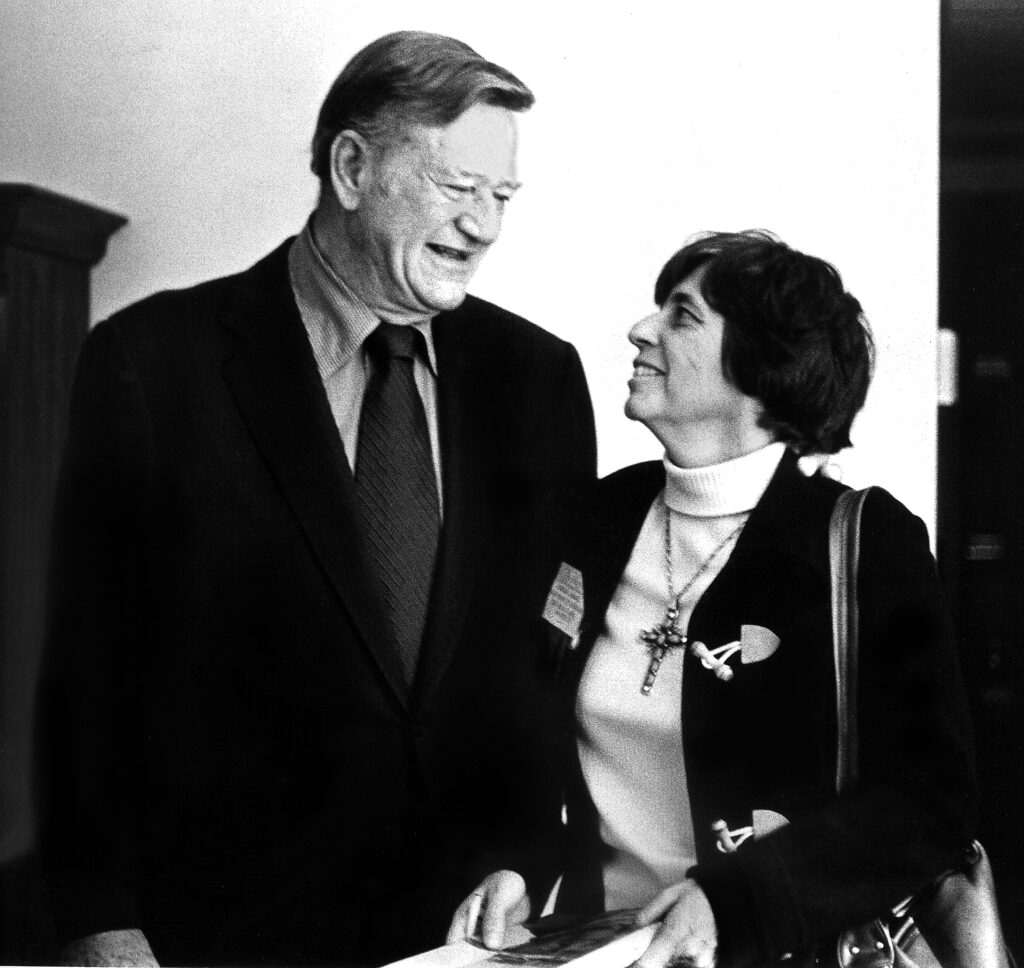
Her roots date back to celebrities like John Wayne (pictured below), with whom she played poker at his home in Orange County, Calif.), and Bob Hope, star of her first big, self-produced and promoted gala. Her friends include performers like Garth Brooks and Reba McEntire. In honor of her birthday, Based on Truth is publishing one chapter from her book, “ACTS of the Heart: The Remarkable Story of Live Entertainment’s Mother Hubbard,” for your enjoyment.
Chapter 9: Bringing Hope Home
[Author’s Note: Barbara (Mother) Hubbard knew, loved and promoted three major comedians in her early days — Bob Hope, Bill Cosby and Red Skelton. But it was Bob Hope who really launched the visionary side of her career. In Chapter 9 of “ACTS of the Heart: The Remarkable Story of Live Entertainment’s Mother Hubbard,” available on Bookbaby, she recounts how reading the newspaper, imagining an event and making it happen became second nature for her during her 50-year career in live entertainment. In honor of her 99th birthday, we’re re-publishing that part of her story here.]
“I go with mom to pick up Bob Hope and we’re in a station wagon. We’re not in a limo, it’s a station wagon!” — Dru Hubbard
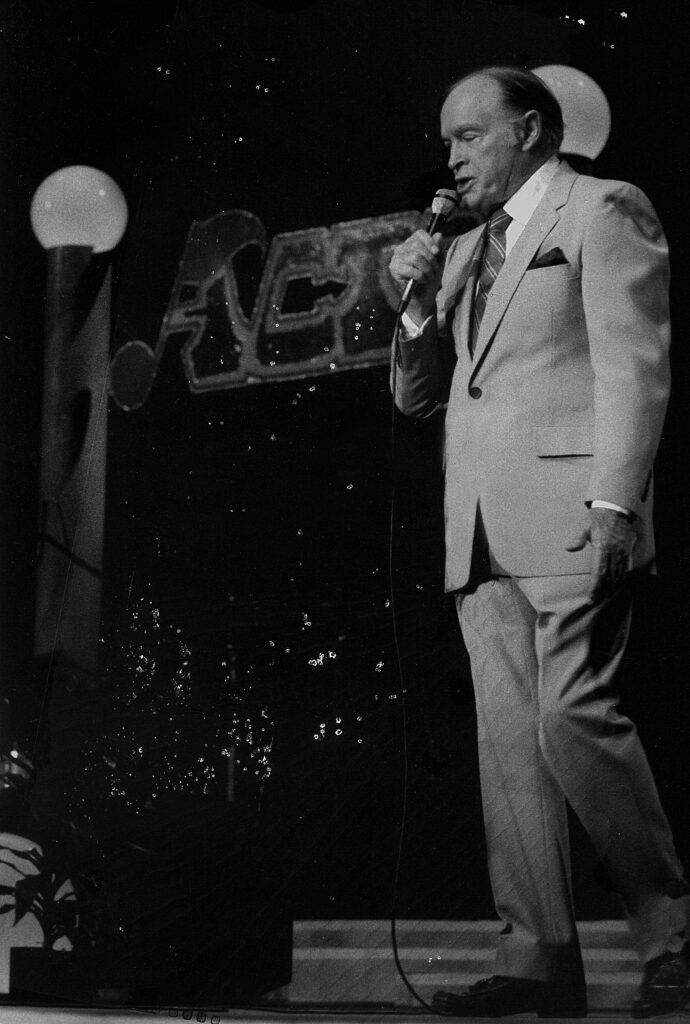
I knew from the beginning that, if the new arena were to survive, it would be on concerts and shows, not just NMSU Aggies basketball and volleyball. Athletics might not have seen it my way at first, but nothing is better than fighting for what you believe. I had promoted plenty of concerts prior to the event I dreamed up with Bob Hope, but those were usually acts on an established tour and I got a date. Scouring the trade papers, newspapers and magazines for information about upcoming tours and developing a relationship with the manager, booking agent and, finally, the artist was a big part of my career at NMSU.
The more shows I booked, the more work for my kids, from ushers to stagehands to marketers. They were the best staff I could have asked for.
I grew up with the Bob Hope Christmas Show for the Troops. He started working with the U.S.O. to entertain our military in 1941. They called him the one-man morale machine. He entertained the U.S. troops in Vietnam from 1964 to 1972 each Christmas holiday, taking talented and pretty young women along to titillate and, just as important, to feed his punch lines.
When I read that he wasn’t going to Vietnam or anywhere to entertain the troops in 1973, a lightbulb went off in my head. Why not bring the experience to him, making it possible for him to interact with the troops stateside? And what better place than the Pan American Center, Las Cruces, New Mexico, surrounded by military installations and with a history of celebrating the armed forces?
I imagine anyone else could come up with plenty of reasons why that wouldn’t be the easiest thing to pull off. I had no idea, being a newbie at promoting concerts, that there was so much red tape with the military, but I’m not one to shy away from a challenge.
That I actually made it happen over Christmas that year has to be the highlight of my career booking and promoting shows at New Mexico State University.
First thing’s first: call the Pentagon. I was searching for Navy Commander Everett Alvarez Jr., the first U.S. pilot to be downed and captured during the Vietnam war and, at the time, the longest prisoner of war (POW) in history.
At the Pentagon, I’m sure they thought, “who is this woman in the middle of nowhere calling us?” But, with enough persistence, I think they realized I meant no harm and got me in touch. Commander Alvarez ended up agreeing to host the event.
Then, I had to get Bob Hope. Not only did I book him on a handshake, which was how we did things back then and, frankly, how I prefer it, but I produced the whole show, brought in enlisted men, veterans, and POWs.
I invited all of the veterans in New Mexico, a state with one of the largest military populations in the U.S., to Pan Am Center. The students constructed a stage in the shape of a ship’s hull in the center of the arena and I borrowed a bell from the nearby Navy base and set it up center stage. We christened the ‘ship’ the U.S.S. Hope.
That afternoon when Bob was going through rehearsal, he noticed the orchestra full of students in a pit in the middle of the stage.
“Well, this is most unique,” I remember him saying. I countered that at least they would catch him if he fell on the way up the stairs to the stage. Little did I know I would be doing the catching.
The event sold quickly, soon selling standing-room only tickets to boost the 13,000-seat capacity of Pan Am Center’s 360° layout. Hundreds of those in attendance were veterans, many of whom were POWs themselves. The arena housed a section for the Army, Navy, Marines and Air Force. All of the local veterans had a place of honor on the stage. They stood, or sat, some showing visible effects of wartime with missing arms or legs; others missing a less tangible piece of themselves.
Though sometimes Pan Am felt enormous, the arena suddenly seemed much more intimate. Sniffles could be heard echoing throughout the facility, some of them were my own.
Bob had rehearsed all day, working the room, walking all around the stage to address the entire audience. But he didn’t know the half of it. We’d kept him in the dark about quite a few aspects of the show.
He did not know the audience would be filled with POWs from the Vietnam War, many friends of his, and representatives from all the armed forces we could gather. And he didn’t know who the emcee would be.
To open the show, we had a big reveal planned. It was dark and the stairs to the stage were steep. I was still concerned, despite my jest that the student orchestra would catch him, so I was right behind him as he climbed onto the deck of the U.S.S. Hope.
As he reached the top step, he took a double take as he was greeted by his friend, Commander Alvarez.
Commander Alvarez, in his white uniform and everything, saluted Bob and said:
“Welcome aboard, Tonto.”
That wasn’t in rehearsal, so Bob didn’t see it coming. That was the moment Bob faltered. I don’t know if it was from surprise or just the emotion of the event. What could I do but give him a nudge forward?
Knowing his entrance was a little awkward, Bob, the king of the ad libbers, turned around and looked down at me in the pit. “Thank you, Mother Hubbard.” And that’s been my moniker ever since.
No one had called me that before Bob, even though it seems perfectly natural given all my kids – both biological and students – and my married name. The people in Las Cruces know me, between teaching them or their kids and bringing in hundreds of shows. Bob was particularly astute at sizing up the local situation. So when he called me Mother Hubbard, people knew it was me down there in the pit. And the name stuck.
I don’t think there are a lot of “Mother Hubbards” out there. Just me and the one who went to her cupboard to fetch her poor dog a bone. Her cupboard was bare, so I hear.
Mine is full and I am very grateful.
— Linda Deckard and Jessica Boudevin TerBorch